

Business owners hire “an SEO writer” and get blog posts when they needed a sales page. Freelancers call themselves copywriters and then get briefs for 2,000-word guides. The confusion is expensive on both sides.
SEO copywriting and SEO content writing overlap, but they do different jobs. One brings people to your site. The other turns those visitors into customers. Most websites need both, in the right places.
This guide explains the real difference between SEO copywriting and SEO content writing, with examples of each, a side-by-side comparison, when to use or hire which, and how to measure whether each one is working.
SEO content writing creates helpful, search-optimised content, like blog posts and guides, to attract organic traffic and build trust over time. SEO copywriting creates persuasive, search-optimised pages, like product pages, service pages, and landing pages, to turn visitors into leads or customers. Content writing earns the visit. Copywriting earns the sale.

Table of Contents
What Is SEO Content Writing?
SEO content writing is creating useful content that answers what people search for, structured so search engines understand it and rank it.
Its main goal is organic traffic and trust. A reader arrives with a question, gets a genuinely useful answer, and starts to see your brand as a reliable source. Some of those readers come back later, join your email list, or buy.
Typical SEO content includes:
- Blog posts and how-to guides
- Comparison and “best of” articles
- FAQ pages and glossaries
- Long-form resources and ebooks
Example: a post titled “How to Choose a Laptop for Freelancing” on an electronics store’s blog. It doesn’t push a single product. It helps the reader decide, and it ranks for a search people make before they’re ready to buy.
Good SEO content matches search intent, covers the topic fully, uses keywords naturally in titles and headings, and links to related pages. For guidance on length, see our post on the ideal blog post length.
What Is SEO Copywriting?
SEO copywriting is persuasive writing for pages that need to both rank and convert. It combines keyword research with the principles of copywriting: clear benefits, proof, objection handling, and a strong call to action.
Its main goal is conversions: sales, sign-ups, enquiries, or bookings.
Typical SEO copy includes:
- Product and category pages
- Service pages (“Web Design in Austin”)
- Landing pages
- Homepages
- Meta titles and descriptions (the copy people see in search results before they click)
Example: the product page for one specific laptop. It targets a buying keyword, highlights the benefits that matter to the buyer, answers objections like warranty and delivery, and ends with a clear “Add to cart.” If you’re new to persuasive writing, start with our ultimate guide to copywriting.
SEO Copywriting vs SEO Content Writing: Side-by-Side
| SEO content writing | SEO copywriting | |
|---|---|---|
| Main goal | Attract traffic and build trust | Convert visitors into leads or sales |
| Search intent | Informational (“how to…”, “what is…”) | Commercial or transactional (“buy…”, “price”, “near me”) |
| Typical pages | Blog posts, guides, FAQs | Product, service, and landing pages |
| Length | Usually longer and in-depth | Usually shorter and focused |
| Tone | Helpful, educational | Persuasive, benefit-led |
| Success metrics | Rankings, organic traffic, time on page, email sign-ups | Conversion rate, leads, sales, revenue per visitor |
How They Work Together
The two aren’t competitors. They’re stages of the same journey.
A reader searches “how to start a Shopify store” and finds your blog post (SEO content). Inside, you link to your Shopify setup service page (SEO copy). The content earned their attention and trust. The copy turned that trust into an enquiry.
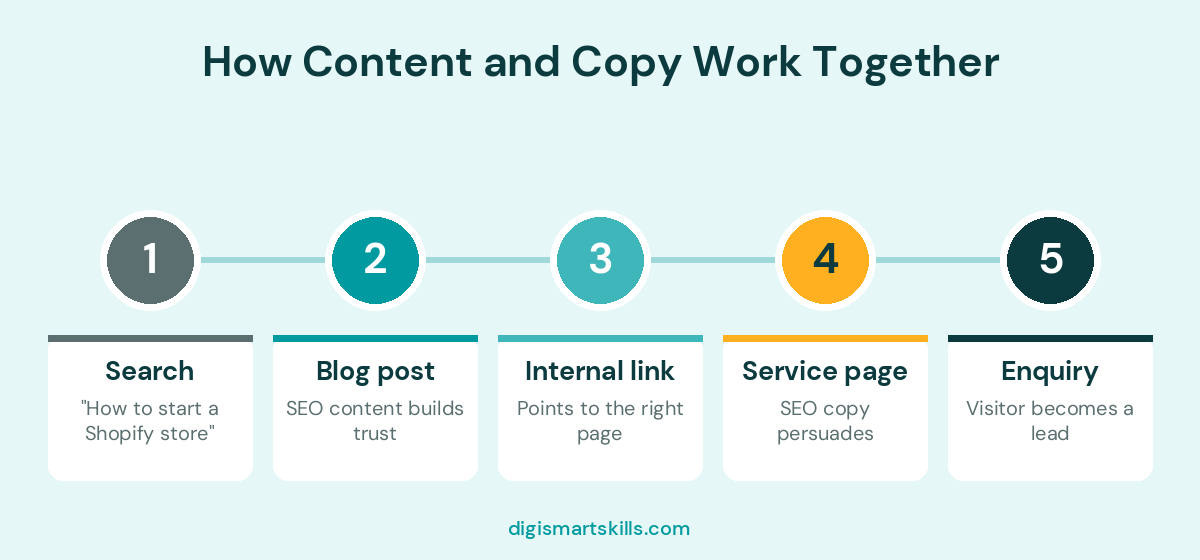
If you only have content, you get traffic that doesn’t convert. If you only have copy, you have sales pages that nobody finds. The internal link between the two is where a lot of websites lose customers, so make sure every relevant blog post points to the right product or service page.
When to Use (or Hire) Each One
Choose SEO content writing when you want to:
- Grow organic traffic from Google
- Build topical authority in your niche
- Answer customer questions before they contact you
- Grow an email list with helpful lead magnets (see how to build an email list from scratch)
Choose SEO copywriting when you want to:
- Get more sales from existing traffic
- Launch or rework product, service, or landing pages
- Improve click-through rates from search results with better titles and meta descriptions
- Run paid ads that send people to a page that needs to convert
If budget only allows one: fix your money pages first. Better copy on pages that already get visitors usually pays off faster than new blog posts that take months to rank.
Skills to Look for in an SEO Writer
Whether you’re hiring or building your own skills as a freelancer, look for:
- Search intent: they can tell whether a keyword needs a guide, a comparison, or a product page.
- Research: they find accurate, current sources and don’t pad articles with unsourced statistics.
- Persuasion basics: even content writers should understand benefits, headlines, and calls to action.
- On-page SEO: titles, headings, meta descriptions, internal links, and image alt text.
- Editing judgement: they use AI tools carefully and fact-check what those tools produce.
Ask for samples that match the job. A great blog writer with no sales page samples isn’t proof they can write converting copy, and the reverse is also true. If you want to offer these skills as a service, our guide on how to start freelancing with no experience walks through building samples and landing clients.
How to Measure Results
Measure each type against its own goal. Judging blog posts on direct sales, or sales pages on traffic, leads to bad decisions.
- For SEO content: track keyword rankings and organic clicks in Google Search Console, plus engagement and email sign-ups in Google Analytics.
- For SEO copy: track conversion rate, leads or sales, and click-through rate from search results. If a page ranks well but few people click, the title and meta description need work. If people click but don’t convert, the page copy does.
Frequently Asked Questions
Is SEO copywriting the same as copywriting?
Not quite. SEO copywriting is copywriting for pages that also need to rank in search, so it includes keyword research and on-page SEO. Traditional copywriting, like print ads, email campaigns, or video scripts, doesn’t need to rank.
Which pays more, SEO copywriting or SEO content writing?
Copywriting often pays more per word because it’s tied directly to sales, but content writing projects tend to be larger and more regular. Rates vary widely by niche, experience, and client, so price on value and results rather than word count alone.
Can one writer do both?
Yes, many good writers do both. Just make sure the brief is clear about the goal of each page, because the structure and tone change depending on whether the page needs to inform or to sell.
Should I use keywords as often as possible?
No. Keyword stuffing makes copy harder to read and goes against Google’s spam policies. Use the main keyword in the title, the first paragraph, and a heading or two, then write naturally.
Use Both, in the Right Places
The difference between SEO copywriting and SEO content writing comes down to the goal of the page. Content writing attracts and educates. Copywriting persuades and converts. A website that grows steadily uses content to bring in the right visitors and copy to turn them into customers, with clear links between the two.
Look at your own site today. Which pages are meant to attract readers, and which are meant to sell? Then make sure each one is written for its actual job.
Join the DigiSmart Skills newsletter for step-by-step guides on SEO, content, and copywriting you can use on your own site or with clients. Learn. Build. Grow.



2 comments
[…] It’s often confused with content writing, but the goals are different. Content writing educates or entertains, usually to build trust and search traffic over time. Copywriting asks for action now. A blog post explaining how to choose running shoes is content. The product page that convinces you to buy a specific pair is copy. We cover the difference in detail in SEO copywriting vs. SEO content writing. […]
[…] Blog and content writing (learn the difference between the two main types in our guide to SEO copywriting vs. SEO content writing) […]