

You’ve read copy that worked on you. A product page that made you add to cart without thinking twice. An email subject line you couldn’t ignore. A single headline that made you stop scrolling.
None of that was luck. It was copywriting: writing designed to get a specific reader to take a specific action.
This guide explains what copywriting is, how it differs from other kinds of writing, and how to write copy that actually persuades. You’ll learn the research that comes before any writing, the classic formulas copywriters rely on, how to write headlines and calls to action, and the mistakes that make copy sound pushy instead of convincing.
Copywriting is writing that persuades a reader to take an action, such as buying a product, booking a call, or signing up for a newsletter. It includes ads, landing pages, product descriptions, sales emails, and social media captions. Good copy focuses on the reader’s problem and the benefit they’ll get, not on the product’s features alone.
Table of Contents
What Is Copywriting (and What Isn’t It)?
Copywriting is any writing whose job is to sell, whether that’s a product, a service, or an idea. The “copy” is the text itself: the words on a billboard, a landing page, a Facebook ad, or a WhatsApp broadcast to customers.
It’s often confused with content writing, but the goals are different. Content writing educates or entertains, usually to build trust and search traffic over time. Copywriting asks for action now. A blog post explaining how to choose running shoes is content. The product page that convinces you to buy a specific pair is copy. We cover the difference in detail in SEO copywriting vs. SEO content writing.
Copywriting also isn’t about clever wordplay. A plain sentence that clearly answers “what’s in it for me?” will beat a witty one that leaves readers confused.
Step 1: Know Your Reader Before You Write a Word
The best copywriters spend more time researching than writing. You can’t persuade someone you don’t understand.
Where to find what your customers really think
- Reviews: read 3-star reviews of your product and your competitors’ products on Amazon, Etsy, or Google Maps. They tell you what people wanted and didn’t get.
- Forums and groups: Reddit, Quora, and Facebook groups show the exact words people use to describe their problem.
- Your own customers: ask them why they bought, what nearly stopped them, and what they’d tell a friend.
- Search data: keyword tools and Google’s “People also ask” box show what people are searching for and how they phrase it.
Copy their language. If customers say “my phone dies before lunch,” don’t write “extended battery performance.” Write “lasts all day, even with heavy use.”
Match the reader’s level of awareness
Copywriter Eugene Schwartz described five stages of awareness in his 1966 book Breakthrough Advertising. Where your reader sits changes what you should say first.
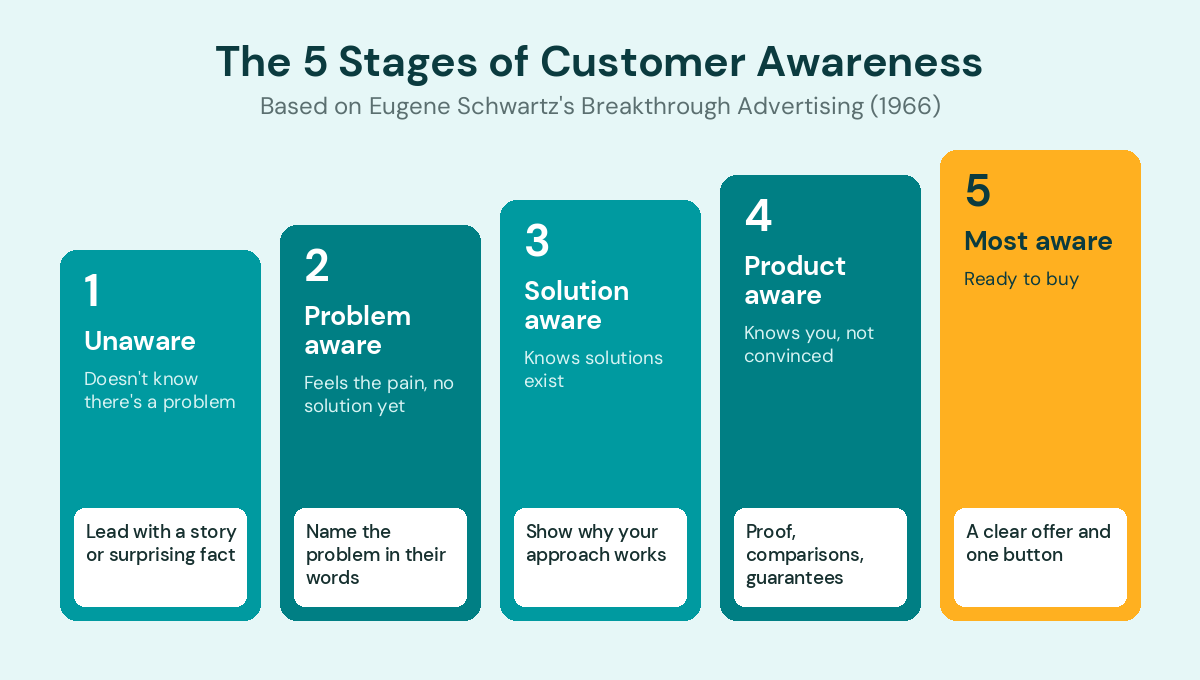
Someone who doesn’t know they have a problem needs a story or a surprising fact. Someone comparing two products needs proof that yours is better. Someone who already wants it just needs a good offer and a clear button.
Step 2: Sell Benefits, Support With Features
A feature is what a product has or does. A benefit is what the customer gets from it. People decide with emotion and justify with logic, so lead with the benefit and use features as proof.
The classic example is Apple’s original iPod in 2001. Apple could have advertised “5GB hard drive.” Instead, it said “1,000 songs in your pocket.” Same feature, but the second version shows you the result.

A quick trick: write down a feature, then add “which means…” until you reach something the customer actually cares about. “20,000 mAh battery, which means you can charge your phone four times, which means you won’t be stuck without a phone on a long trip.”
Step 3: Use a Proven Copywriting Formula
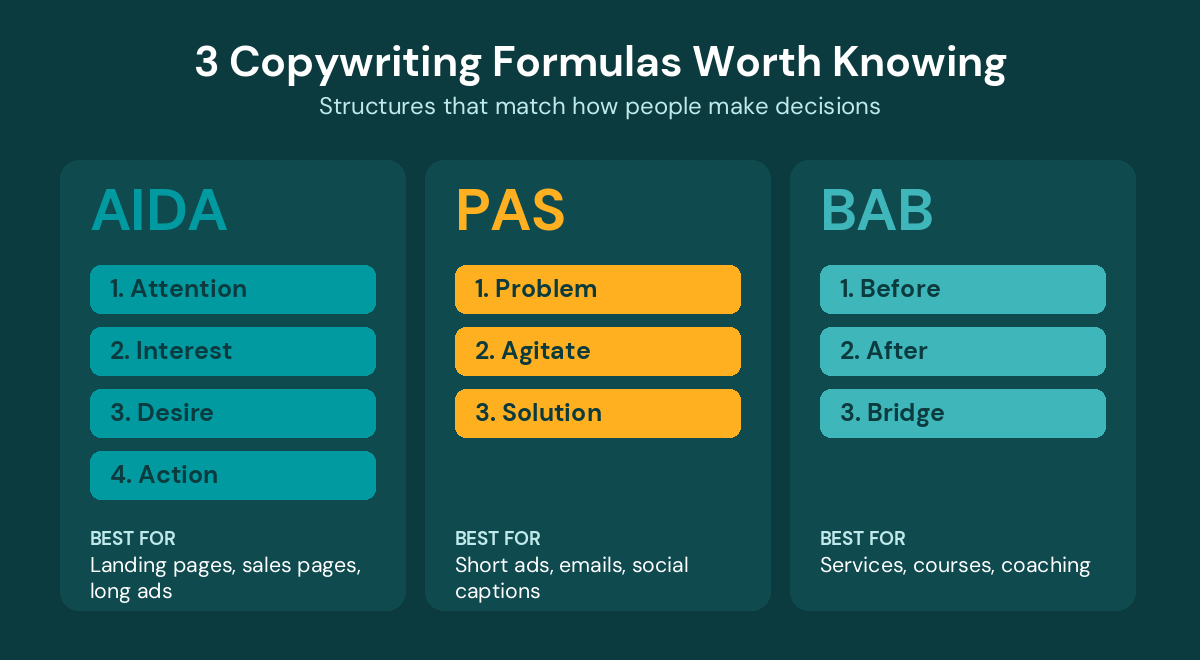
Formulas aren’t templates to fill in blindly. They’re structures that match how people make decisions. Here are the three most useful for beginners.
AIDA: Attention, Interest, Desire, Action
AIDA is one of the oldest models in advertising, usually credited to the American advertiser E. St. Elmo Lewis in the late 1800s. Grab attention with a headline, build interest with a relevant detail, create desire by showing the result, then ask for action.
PAS: Problem, Agitate, Solution
PAS works well for short copy like ads and emails. Name the problem, make the reader feel its cost, then present your solution.
Example for a tutoring service in Chicago:
Problem: Your child’s math grades keep slipping.
Agitate: The SAT is four months away, and every week of falling behind makes catching up harder.
Solution: Our tutors meet your child twice a week and send you a progress report every Friday. Book a free trial session today.
BAB: Before, After, Bridge
Describe life before your product, paint the picture after, then show your product as the bridge between the two. It’s great for services and transformations, like courses, coaching, or fitness.
Step 4: Write Headlines People Can’t Ignore
Your headline decides whether anyone reads the rest. Research from the Nielsen Norman Group has long shown that people scan web pages rather than read them word for word, so the headline and subheadings do most of the work.
Headline types that work:
- How-to: “How to Get Your First 10 Clients on Fiverr”
- Specific numbers: “7 Mistakes That Make Your Shopify Store Look Untrustworthy”
- A direct question: “Still Paying for Software You Never Use?”
- A call-out: “Freelancers in the US: Read This Before Tax Season”
- A clear promise: “Learn Basic Excel in One Weekend”
Be specific and be honest. A headline that overpromises gets the click but loses the reader, and on ad platforms it can get your ad rejected.
Step 5: Write Body Copy That Keeps People Reading
- Write to one person. Use “you” more than “we.” The reader cares about their problem, not your company history.
- Keep it simple. Short sentences and everyday words. If a 12-year-old couldn’t follow it, simplify.
- Be specific. “Delivered in 48 hours anywhere in Texas” beats “fast delivery.”
- Show what makes you different. Your unique selling proposition (USP) answers “why you and not the other option?” Free returns, a local warehouse, a money-back guarantee, a niche specialism.
- Handle objections. Price, trust, timing, and “will this work for me?” Answer them before the reader has to ask.
Step 6: Add Honest Social Proof
People trust other customers more than they trust you. Social proof includes reviews, testimonials, case studies, client logos, and real numbers like “2,400 orders delivered.”
Only use proof that’s real. Never write testimonials yourself or invent customer numbers. Fake reviews damage trust when they’re spotted, and in many countries, including the US, they’re illegal. A few genuine reviews with names and photos beat a wall of perfect five-star quotes.
Step 7: End With a Clear Call to Action
Every piece of copy needs one clear next step. Tell readers exactly what to do and what they’ll get.
- Use an action verb: “Get,” “Book,” “Download,” “Start”
- Say what happens next: “Book my free trial session” beats “Submit”
- Remove risk: “No credit card required” or “Cancel anytime”
- Ask for one action only. Two competing buttons split attention
Urgency works when it’s real (“Offer ends Friday”). Fake countdown timers that reset on every visit destroy trust fast.
Types of Copywriters
If you’re thinking of copywriting as a career or a freelance skill, these are the main specialisms:
- Direct response copywriters write sales pages, emails, and ads designed for immediate action.
- SEO copywriters write web pages and product descriptions that rank in search and convert visitors.
- Brand copywriters create taglines, slogans, and brand voice, like Nike’s long-running “Just Do It.”
- Social media copywriters write captions, ad copy, and short scripts. Our social media copywriting tips cover this in more depth.
- Technical copywriters explain complex products, like software or engineering tools, in plain language.
Common Copywriting Mistakes
- Writing about yourself instead of the reader
- Listing features with no benefits
- Using vague words like “best quality” and “great service” without proof
- Making several offers in one piece
- Publishing AI-generated copy without editing it for your audience and checking every claim (see how to use AI for blogging)
Frequently Asked Questions
What’s the difference between copywriting and content writing?
Copywriting persuades readers to take an action now, like buying or signing up. Content writing informs or entertains to build trust and traffic over time. Many writers do both, but the goal of each piece decides which one it is.
Can I learn copywriting without a degree?
Yes. Clients care about results and samples, not degrees. Study good ads and sales pages, practise rewriting them, and build a small portfolio. Our guide on how to start freelancing with no experience shows how to turn that into paid work.
Will AI replace copywriters?
AI can draft copy quickly, but it doesn’t know your customers, can’t interview them, and often states things that aren’t true. Copywriters who understand research, positioning, and testing, and who use AI as a tool, are in a far stronger position than those who don’t.
How long should copy be?
As long as it needs to be to answer the reader’s questions, and no longer. A cheap, familiar product might need two lines. An expensive course or service usually needs a longer page that handles more objections.
Start Writing Better Copy Today
Good copywriting isn’t a talent you’re born with. It’s a process: understand the reader, lead with benefits, follow a proven structure, prove your claims, and ask for one clear action.
Pick one piece of copy you already have, like your website’s homepage, a product description, or your Instagram bio, and rewrite it using the steps in this guide. Then compare the results.
Join the DigiSmart Skills newsletter for practical guides on copywriting, content, and digital marketing you can apply straight away. Learn. Build. Grow.



3 comments
[…] treat made-up names and fake credentials as deceptive, and readers usually spot them anyway. Our ultimate guide to copywriting can help you write an About page that sounds […]
[…] you’ve never done audience research, our ultimate guide to copywriting shows how to mine reviews and forums for the exact words your customers […]
[…] you offer should have its own page, written for the customer rather than about your company. Our ultimate guide to copywriting shows how to write pages that […]