

Every job post asks for experience. Nobody wants to be your first client. That loop stops most beginners before they send a single proposal.
Here’s what breaks it: clients don’t really buy experience. They buy confidence that you can fix their problem. Past work is one way to prove that. It isn’t the only way, and you can build that proof yourself in a few weeks.
This guide walks you through how to start freelancing with no experience, one step at a time. You’ll pick a skill people actually pay for, create proof before anyone hires you, choose the right platform, price your first jobs, and land that first client. If you’re still unsure whether freelancing suits you at all, read What is Freelancing: Is It the Right Career for You? first, then come back here.
Pick one in-demand skill you can learn in 4–8 weeks. Create three sample projects that show it. Build a focused profile on one platform. Price your first 3–5 jobs a little below the market rate, and send short, specific proposals every day until you land a client. The reviews from those first jobs become your experience.
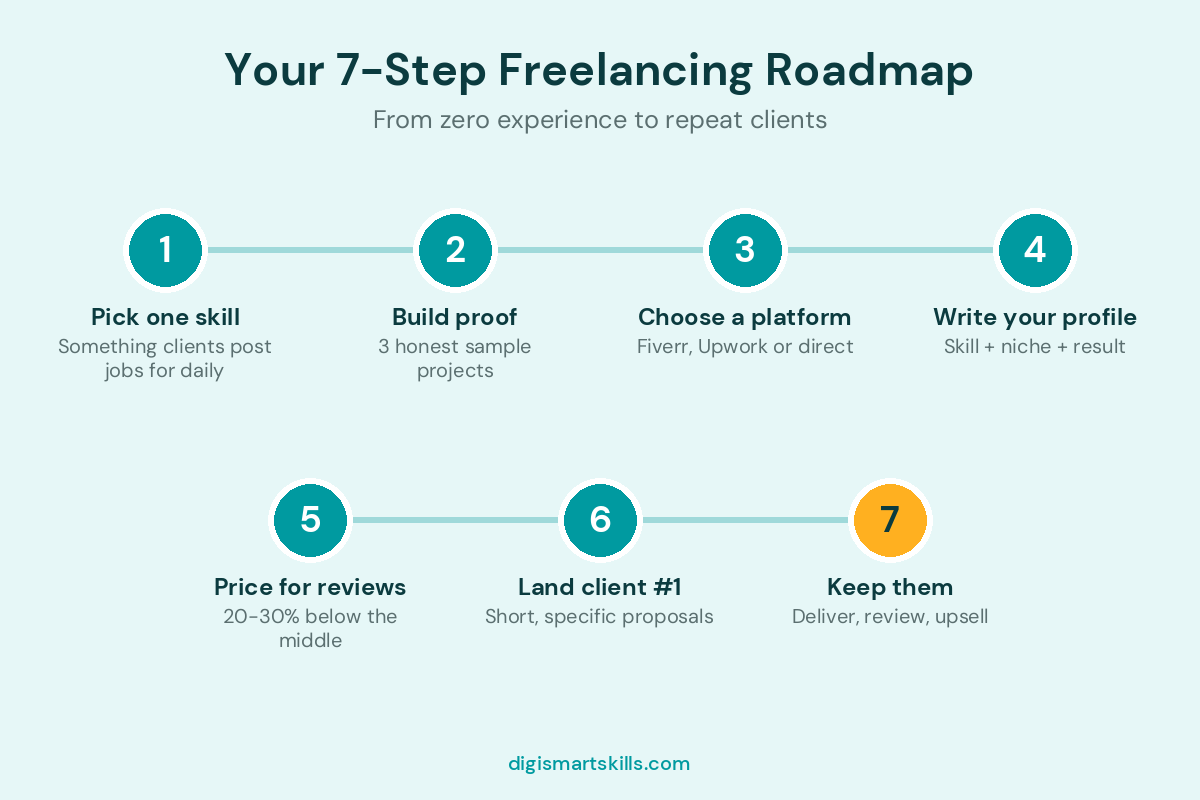
Table of Contents
Step 1: Pick One Freelance Skill Clients Already Pay For
Don’t start with “what am I passionate about?” Start with “what are businesses hiring for every day?” Search a skill on Upwork or Fiverr and check how many active listings there are and what clients are paying.
These beginner freelance skills have steady demand and a short learning curve:
- Blog and content writing (learn the difference between the two main types in our guide to SEO copywriting vs. SEO content writing)
- Social media management and basic ad setup
- WordPress and Elementor websites for small businesses
- Graphic design for social posts, thumbnails, and simple brand kits
- Virtual assistance: inbox, calendar, research, and data entry
- Short-form video editing for Reels, TikTok, and YouTube Shorts
Pick one, not three. “Writer, designer, VA, video editor” tells a client you’re not especially good at any of them.
How long does it take to learn a freelance skill?
For most of the skills above, 4–8 weeks of practice at 1–2 hours a day is enough to deliver basic client work. That’s a rough estimate, not a promise. You won’t be an expert, and you don’t need to be. You only need to be better than the client at the task they’re hiring for.
Step 2: Build Proof Before Anyone Hires You
This is the step that fixes the “no experience” problem. Instead of waiting for someone to give you experience, you create it. It’s also the part most guides on freelancing for beginners skip.
Make three sample projects that look like real client work:
- Writer: three blog posts in one niche, published on Medium, LinkedIn, or your own site
- Designer: a set of social posts redesigned for a local brand you like
- Web builder: a three-page site for a fictional bakery or a relative’s shop
- Social media manager: a two-week content calendar plus six finished posts for a sample brand
Label these honestly as “concept” or “practice” projects. Passing off a mockup as paid work falls apart the moment a client asks a follow-up question.
Where to find your first real projects
A real project, even an unpaid one, beats a sample. Offer help to a relative’s shop, a friend’s small business, a local NGO, or a tuition centre. Ask for one honest written testimonial in return. A single line from a real person beats five polished mockups.
Freelance portfolio basics
You don’t need a custom website on day one. A free Behance profile, a Notion page, or a Google Drive folder of clean PDFs works. For each sample, show the problem, what you did, and the result. Clients skim, so keep it to three pieces.
Step 3: Choose Your First Freelance Platform
Start on one platform. Five half-finished profiles get you zero reviews anywhere.
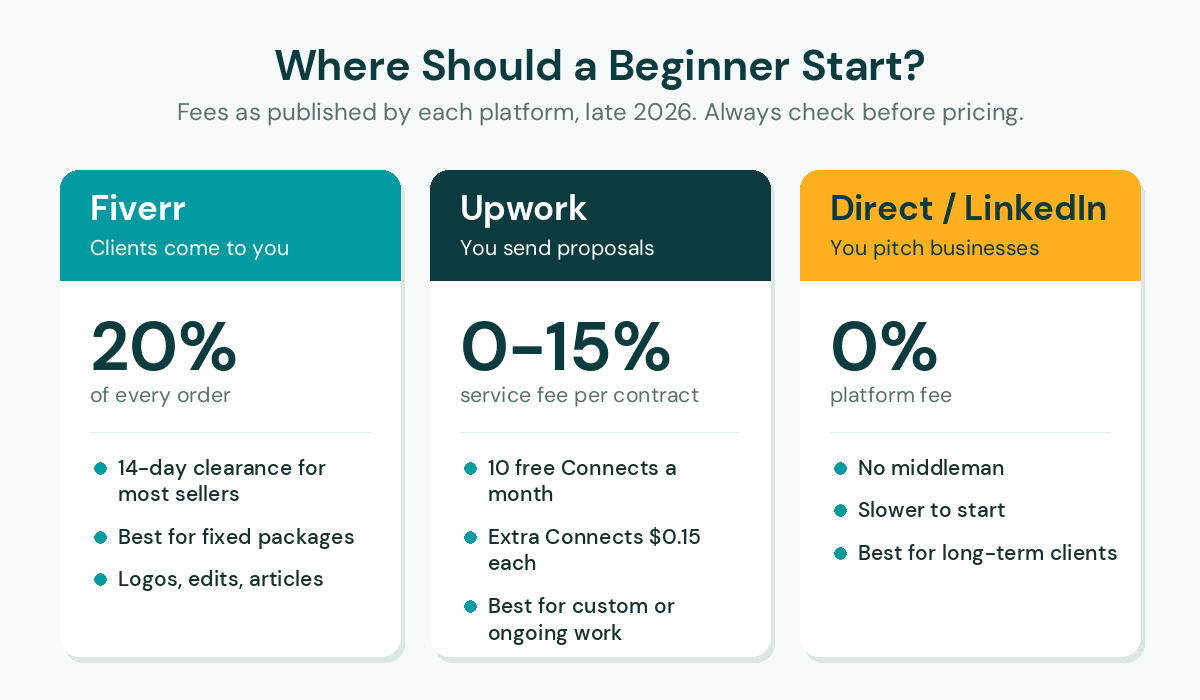
| Platform | How you get work | What it costs you | Best for |
|---|---|---|---|
| Fiverr | Clients find and buy your gig | 20% of every order. Earnings clear after 14 days for most sellers | Fixed packages: logos, edits, posts |
| Upwork | You send proposals to job posts | 10 free Connects a month, extra Connects at $0.15 each. A service fee of 0–15%, shown before you accept a contract | Custom, hourly, or ongoing work |
| LinkedIn / direct outreach | You pitch businesses yourself | No platform fee | Higher-paying, long-term clients |
Fees as published by each platform in late 2026. They change often, so check the platform’s help centre before you set prices.
Which one should you pick? If your skill sells as a fixed package (a logo, a 1,000-word article, a 60-second edit), start on Fiverr. For custom work like websites or ongoing VA support, start on Upwork. Either way, post on LinkedIn from week one. It’s free, and no platform can take that pipeline away from you.
Sort out payments before you need them
Check which withdrawal methods work in your country before signing up. In the US, the usual options are a direct transfer to your bank account or PayPal. Expect withdrawal and currency-conversion charges on top of the platform’s cut.
Step 4: Write a Freelance Profile That Sells With No Experience
Your profile has one job: make a client think, “This person gets my problem.”
- Headline: skill + niche + result. “SEO Blog Writer for SaaS Brands | Researched, Easy-to-Read Articles” beats “Freelance Writer.”
- First two lines: talk about the client’s problem, not your life story. Search results often show only these lines.
- Proof: link your three samples. Add relevant free certifications such as Google Skillshop or HubSpot Academy courses.
- Photo: a clear, friendly face on a plain background.
The most common beginner mistake? “I am new but very hardworking.” Nearly every new profile says it. Show the work instead.
Step 5: Price Your First Freelance Jobs to Win Reviews
Your first 3–5 jobs are about reviews, not income. Price a little below the market, but not at rock bottom.
Here’s a simple way to set your starting rate:
- Find 10 freelancers offering the same service who have 20+ reviews.
- Note their prices and find the middle of that range.
- Start about 20–30% below that middle figure.
- Raise your price after every 3–5 five-star reviews.
Don’t go too cheap. Bargain hunters are often the hardest clients to please, and endless revisions on a $5 job cost more than they pay. Remember the platform fee, too: on Fiverr, a $50 order pays you $40 before withdrawal charges.
Step 6: Land Your First Freelance Client
Write proposals that actually get replies
Most beginner proposals are long, generic, and all about the freelancer. Flip that: under 100 words, all about the client.
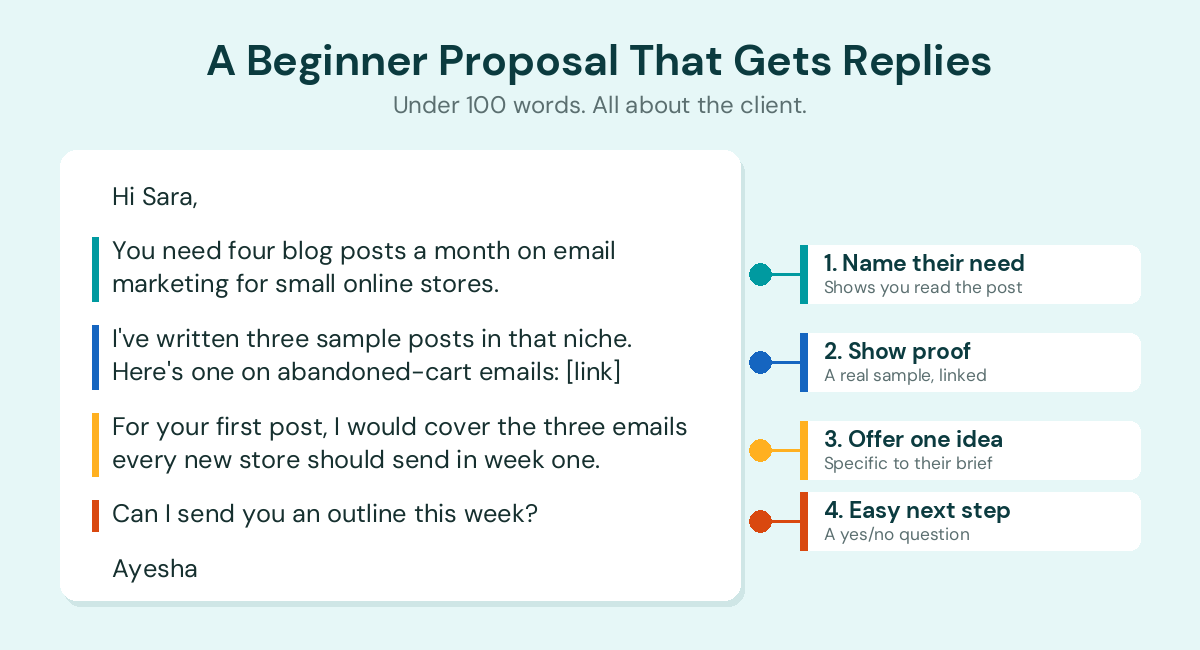
A proposal like this works because it names their need, shows proof, offers one specific idea, and ends with an easy next step. Copywriting principles help here, too. Our ultimate guide to copywriting covers how to write for a reader who’s busy and skeptical.
Apply early and apply daily
Fresh job posts have fewer proposals competing for attention. Turn on job alerts and apply to 3–5 well-matched jobs a day instead of 30 random ones.
Don’t ignore the people you already know
Tell people what you do. A WhatsApp status or LinkedIn post like “I’m taking on two small website projects this month at a starter rate” can do more than a week of proposals. Plenty of first clients come from someone who already trusts you.
Step 7: Turn One Client Into Steady Freelance Work
Landing the first client is the hard part. Keeping them is easier, and cheaper than finding a new one.
- Over-communicate. Confirm the brief in writing, share progress midway, and deliver on time.
- Ask for the review. Once the client is happy, ask once, politely.
- Offer the next step. “Want me to handle next month’s posts too?” is often all it takes.
- Track everything. Log client, rate, hours, and payment date in a simple spreadsheet.
Frequently Asked Questions
Can I start freelancing with no skills at all?
Not really. You need at least one skill someone will pay for. Writing, social media management, and basic design can reach a client-ready level in a few weeks of steady practice, often using free courses.
How long does it take to get your first freelance client?
It depends on your skill, platform, and how often you apply. With solid samples and a few targeted proposals a day, expect anywhere from a couple of weeks to two or three months. Beginners who quit after the first week of silence rarely get there.
Which freelancing platform is best for beginners?
Fiverr suits fixed-price packages, because clients come to you. Upwork suits custom or ongoing work, but you pay Connects to apply. Pick the one that matches how your skill is sold.
Do I need a laptop to start freelancing?
For most skills, yes. Writing, web design, editing, and VA work need a laptop or desktop and stable internet. A phone covers some social media tasks but limits what you can take on.
Start This Week, Not “Someday”
That’s how to start freelancing with no experience: one skill, three honest samples, one focused profile, and the patience to send good proposals every day. Your first review is the hardest to get. After that, it gets easier.
Pick your skill today, give yourself four weeks to build your samples, and then start applying.
Join the DigiSmart Skills newsletter for practical freelancing, blogging, and digital marketing tips you can use straight away. Learn. Build. Grow.




2 comments
[…] Study good ads and sales pages, practise rewriting them, and build a small portfolio. Our guide on how to start freelancing with no experience shows how to turn that into paid […]
[…] marketplace has different fees and rules. Our step-by-step guide on how to start freelancing with no experience compares Fiverr, Upwork, and direct outreach, and walks you through landing your first […]